Our Approach
We create solutions that make everyday life easier for users, increase productivity and contribute to the long-term value of your brand. For us, ergonomics is not just a bonus, but a strategic lever – for greater productivity, fewer operating errors and strong user loyalty. Thanks to our in-depth knowledge of product development and our experience in ergonomic design, our work ensures that your products meet the highest standards in terms of functionality and handling.

How we work
From user analysis through to design engineering
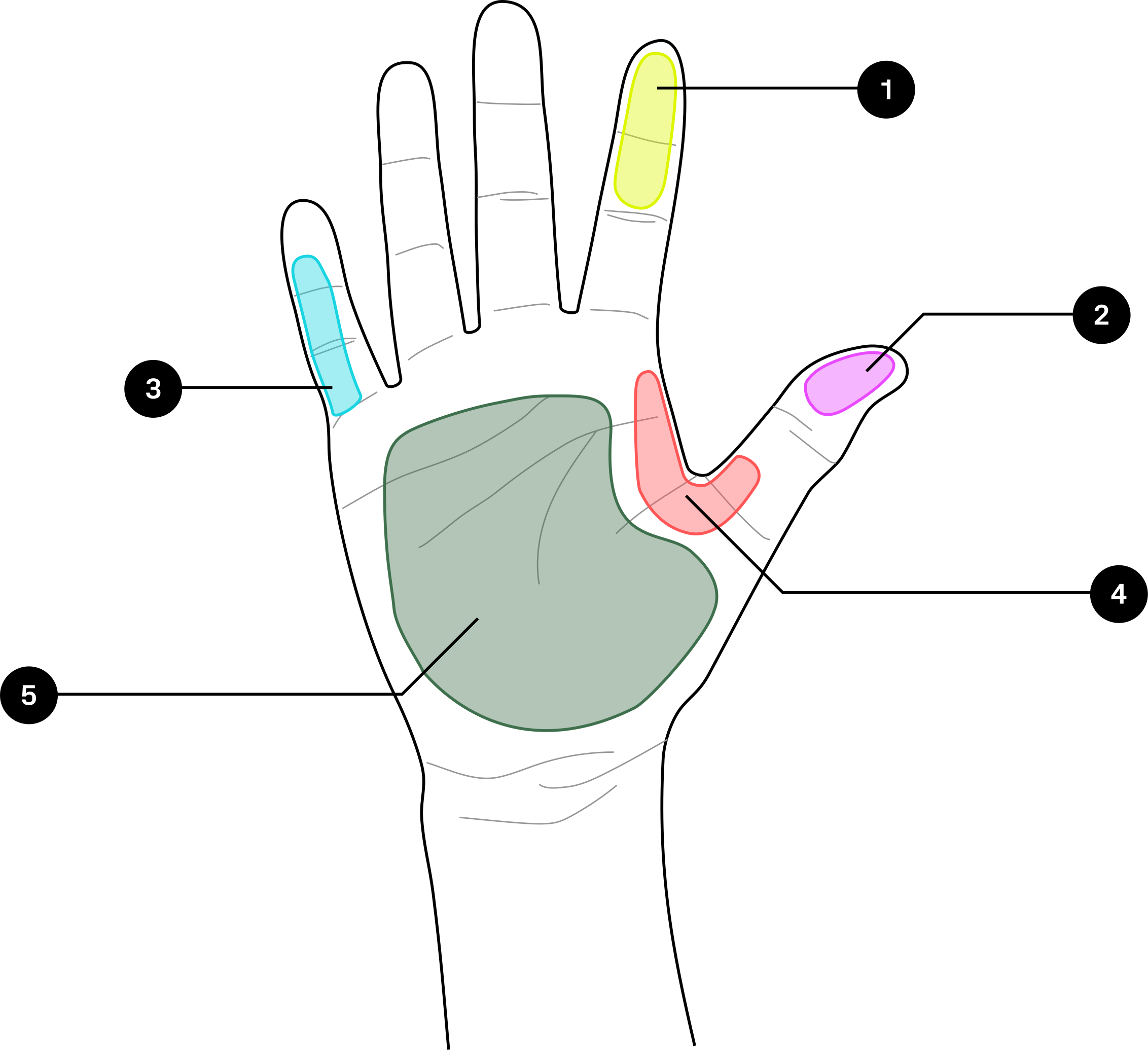
We develop ergonomic solutions for complex industrial products used by professionals on a daily basis. Our work always begins with analysing real-world usage scenarios. This includes examining physical interactions such as posture, movement sequences, applied forces, lines of sight and reach, as well as cognitive interactions: user expectations, clarity of workflows, mental models and typical misinterpretations.
On this basis, Squareone formulates hypotheses for improving interaction, which are rigorously tested through prototypes, mock-ups, ergometric models, video observation and user testing. Iterative prototyping is particularly valuable: ergonomic questions are materialised early, variants can be directly compared, and solutions are refined step by step.
Topology analyses help to abstract and systematically optimise the key interaction points of a product – both in its physical structure and within the interface. This process runs throughout all phases of product development, ensuring that ergonomic insights are consistently translated into design, engineering and design engineering.

Reliable and professional
Proven in the most demanding insdustrial environments
Squareone’s ergonomic expertise has been proven across numerous industrial projects with stringent requirements in terms of safety, sustained use and everyday practicality. In tool development, mechanical engineering, electrical engineering, construction, HVAC, and automotive-related applications, we have demonstrated how ergonomic principles can be systematically understood and applied across a wide range of use contexts.
Thanks to the breadth of our experience and our analytical and technical depth, we identify solutions that are robust in functional, technical and design terms.
For our clients, reliability in implementation is also a key factor. At Squareone, ergonomic solutions are consistently carried through to design engineering and technical realisation. We work closely and on equal footing with development and engineering teams, ensuring that ergonomic quality does not remain a concept, but becomes genuinely effective in the finished product.


Position within our service offering
Ergonomics as both a core capability and a standalone service
At Squareone, ergonomics is both a dedicated capability within development and an integral part of many product development projects. It can be applied as a core component of product development or commissioned as a standalone service to analyse and improve existing products.
Beyond this, ergonomics is often a key element within broader development and transformation initiatives – for example when restructuring product portfolios or fundamentally rethinking usage concepts. Its close integration with product development, software ergonomics, UI/UX and design engineering ensures that ergonomic quality is sustainably embedded within the product.

Starting Point
Isolated ergonomic fixes to usability issues
Companies typically come to us when they start losing business because competing products are perceived as “easier to use”. Sometimes this is driven by clear signals from customers: training takes too long, support teams are overstretched, and user errors are increasing. In other cases, it’s a growing concern that even the next technically advanced solution may fall short in everyday use. These challenges are difficult to address systematically within the organisation.
This becomes particularly evident with products used in highly demanding environments – for example when operated with gloves, under noisy conditions, in continuous use or under time pressure. In such contexts, it is not enough to address ergonomics in isolation; what’s needed is an integrated view of actual usage – physical, cognitive, and across the interaction of hardware and software.
What is often missing internally is the analytical framework and experience required to translate ergonomic issues into sound development decisions. As a result, ergonomics is frequently treated as a late-stage correction, rather than being systematically embedded as a foundation from the outset of development.
Related Services
Ergonomics as part of our service range
Ergonomics is one of the most important aspects of product development. Products developed without considering ergonomics are neither enjoyable to use nor sustainably functional in the long term. In many cases, ergonomics is not viewed in isolation but forms part of several services related to industrial design.
You can find our additional areas of expertise here: